
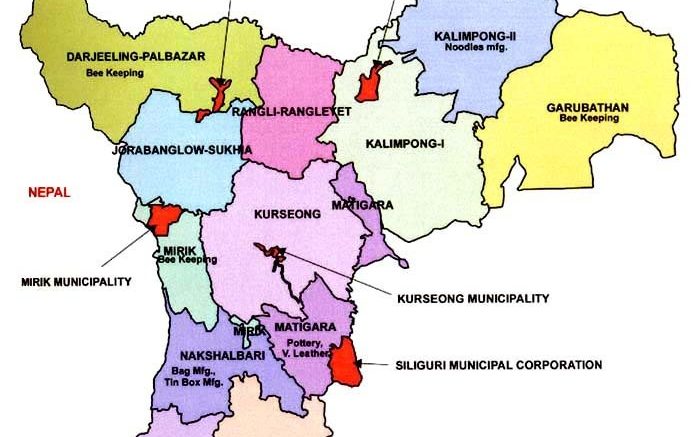
Siliguri District and The Hollowing Out of Darjeeling, author Anjani Sharma Bhujel explains how a proposed new district of Siliguri would formalise forty years of quiet extraction from the hills
The recent proposal to form a separate district of Siliguri, and cut it away from Darjeeling is not a sudden change. It marks the end of a forty-year shift, where resources meant for the hills have quietly moved to the plains. Making Siliguri a new district would lock in this imbalance and break the territorial basis of the Gorkha claim, which is older than Indian Independence. This could happen without any debate in the legislative assembly, or the Parliament.
Leaders from Darjeeling, Kurseong, Mirik, Kalimpong, Siliguri, and Dooars owe the people a clear public stance. Staying silent is also a choice. Every elected representative from Darjeeling, Kurseong, Mirik, Kalimpong, Siliguri and Dooars owe the people of the hills a clear, public position. Their silence is itself a position.
The proposal on the table
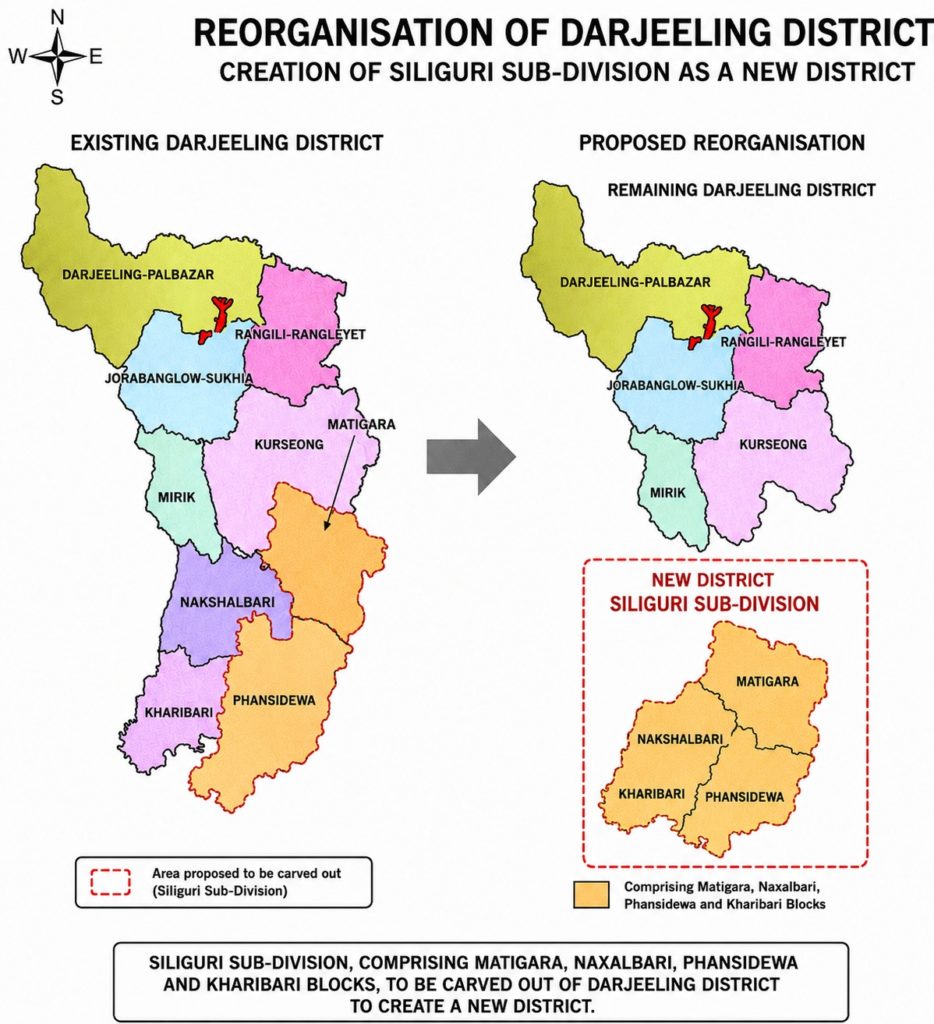
The new district idea has been set in motion with a letter sent by the Matigara-Naxalbari BJP MLA Anandamay Barman to the chief minister. The letter suggests that the entire Siliguri sub-division, Matigara, Naxalbari, Phansidewa and Khoribari blocks, be separated from Darjeeling and joined with the Dabgram-Fulbari areas of Jalpaiguri district, to form a new district called Siliguri.
There is a new government in the state, of which MLA Anandmay Barman is a second time elected leader, and Siliguri MLA Shankar Ghosh and Phansidewa MLA Druga Murmu on the treasury benches, who could push forward with this.
Since, this is just at a proposal state, we still have time to make a strong case against the separation of our historic territorial areas. But for that to happen, the arguments and resistance against any such move must begin now.
The Siliguri district proposal does not arrive in isolation. In the same fortnight in May 2026, the new state government has cleared the transfer of seven national highway stretches from the state PWD to central agencies, with NHAI taking over NH-31, NH-33 and NH-312, and NHIDCL taking over the Sevoke-Coronation Bridge stretch, Siliguri-Darjeeling stretch, the Hasimara-Jaigaon route and the Changrabandha corridor. Five of the seven stretches pass through the Siliguri Corridor itself. NH-10 to Sikkim and NH-110 to Darjeeling, the two highways most directly serving the hills are among those, now under central control.
In parallel, the state has transferred one hundred and twenty acres of land in the Chicken’s Neck to the Border Security Force for India-Bangladesh border fencing. Three substantial restructurings of North Bengal’s administrative geography in three weeks, all under a national-security framing, all moving at a pace that previous state governments had been unable or unwilling to match.
I strongly believe, among all these, the Siliguri district proposal is the most consequential of the three because it changes the civil-administrative authority over land, people, revenue and policing. It is not just the engineering control of road surfaces or the fencing of a border line, yet it is not separate from the other. They constitute a pattern, and the pattern itself merits attention.
The slow shift of power that nobody noticed
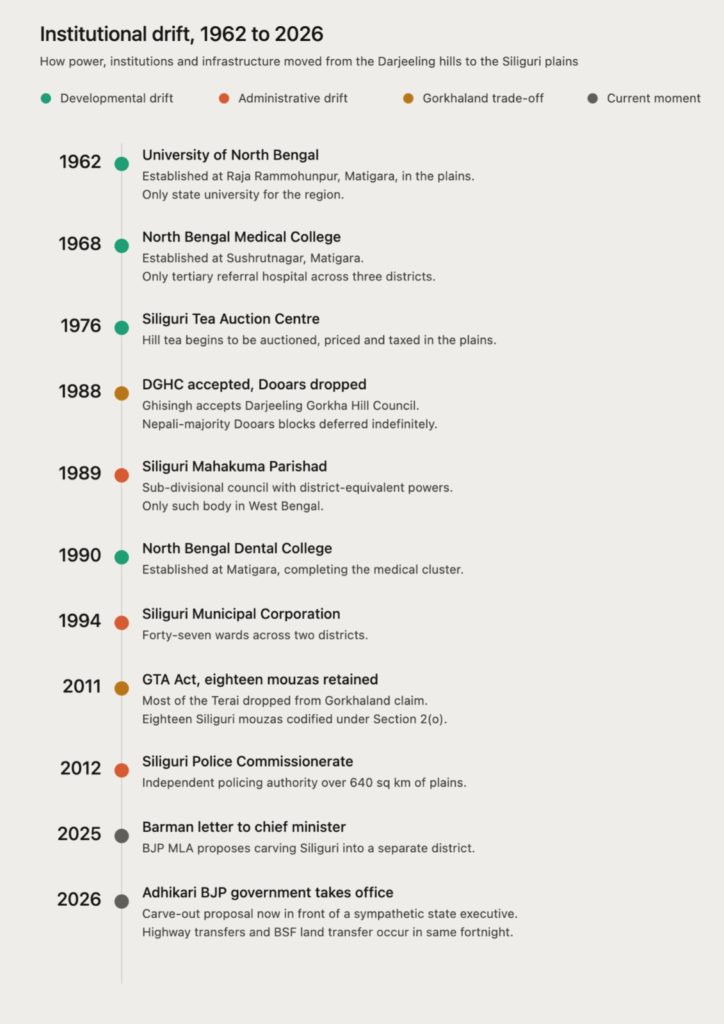
It is not impulsive idea to separate Siliguri off from Darjeeling. It’s the official recognition of the process, which has been ongoing, administratively and developmentally, for much of the last forty years. The power in our region has been gradually shifted from the hills to the plains. Institutions and infrastructure have been allocated for the entire district of Darjeeling, was cunningly spent and shifted to a single sub-division, which is now proposed to be a new district.
The institutional drift must be taken into account first. The Siliguri Mahakuma Parishad was set up in 1989 as a sub-divisional council which has district level powers, the only one of its kind in entire India.
In 1994 the Siliguri Municipal Corporation was formed with forty seven wards in two districts, and the Siliguri-Jalpaiguri Development Authority was formed to garner urban-planning powers which were previously held by the Darjeeling district administration.
Siliguri Police Commissionerate was established in 2012, with the jurisdiction of over 640 sq kilometers of Siliguri city and the adjoining sub-urban areas in the plains.
Every single step, seen in isolation seemed in each case to be a legitimate urban-administrative reform. But when seen holistically, it clearly emerges that they were all a part of the major plan, without anyone being aware of it as a part of the one larger project – to separate Siliguri from Darjeeling. The hills weren’t complaining. In most cases the hills did not even know what happened, they were occupied in changing flags and establishing new kings.
Let’s now look at the developmental drift, which is the more significant half of the story. It was established in 1962 with the aim of catering the needs of the entire region, the University of North Bengal was located in Matigara, in the plains, not in the hills, at Raja Rammohanpur.
In 1968, the Medical College of North Bengal was established to cater to the population of the same region and was located once again in the plains at Sushrutnagar in Matigara. In 1990, North Bengal Dental College was built and now it is housed at Matigara.
Bagdogra airport, in Darjeeling district by virtue of sitting in Naxalbari block, was built and progressively upgraded through grants attributed to district aviation infrastructure, with every new runway extension and terminal expansion booked to the district’s account.
The Industrial Estate of North Bengal was established at Matigara. NH 4 to Sikkim was four laned in Siliguri sub-division. No parts of the Asian Highway corridor, which connects Bhutan/India and Bangladesh is outside the proposed carve-out area as it goes through Bagdogra and Phulbari.
The recently announced underground railway to pass through the Siliguri corridor, which is of national-security importance in the field of defence logistics and is worth several thousand crore rupees, ends at Siliguri sub-division.
On paper, every one of these is “Darjeeling district infrastructure,” paid for out of central and state allocations attributed to a district whose three hill sub-divisions never saw the spending.
This is the main problem with the Siliguri district proposal, and it should be said plainly. For the last forty years, Siliguri’s progress has been counted as “Darjeeling district’s” success. The airport appears in the tourism brochures. University appear in the education ministry reports. The medical college appears in the health budget speeches. The highway appears in the NHAI map books. The hills have been the brand; the plains have been the beneficiary.
The plan-document accounting that allowed central and state allocations to flow into Siliguri infrastructure under the heading of “Darjeeling district development” has been the financial mechanism through which the hills have funded their own marginalization. Money meant for Darjeeling’s development was mostly spent in Siliguri, so the hills ended up paying for their own neglect.
Technically and legally every rupee spent in Matigara, Naxalbari, Bagdogra was the rupee of the district, it was also the hills’ rupee since the hills were part of the district. None of it returned to the hills. None of the institutions built with it serve the hills directly. None of the highway alignments reach the hills.
When Siliguri is carved out as a separate district, every one of those assets physically leaves with it. They were never retained by the hills in any meaningful administrative sense. They merely appeared in Darjeeling district statistics, in its audited accounts, in its representation to Delhi and Kolkata. After the carve-out, even that fiction ends. That is the total inheritance of forty years of being “Darjeeling district” while Siliguri’s growth was being recorded as the district’s growth.
The hills produce, Siliguri trades
The institutional drift described above has hardened into a single contemporary reality. Darjeeling district today is a producer-region whose produce is monetised, traded, valued and taxed almost entirely in Siliguri.
The best-known example is, of course, the tea of Darjeeling. The premium GI Marked leaf grown in the eighty-seven recognised gardens above 1,000 metres in the areas of Darjeeling-Pulbazar, Kurseong, Mirik, Jorebunglow-Sukhia and Rangli-Rangliot is auctioned in the Siliguri Tea Auction Centre. The centre started in 1976 and is one of the major tea auctions in India, and where a hill kilogram of tea turns into a national or international price. Auctioneer commissions, brokerage fees, warehousing rents and the GST on the sale all accrue to the place of auction.
The growers retain the cost of production and a fraction of the realised price. The value is captured in Siliguri.
The same pattern repeats across every category of hill produce. The Siliguri Regulated Market, or mandi of Siliguri is one of the biggest wholesale markets for agriculture products from the hills and Terai to the plains, to the rest of India and the trans-shipment routes to Bhutan, Bangladesh and the North East.
In Bidhan Market, wholesale fruit and vegetables, oranges from Sittong, Mirik, cardamom from higher slopes and ginger from Kurseong-Pulbazar are sold. Siliguri is the entry point for every single source of income from a hill harvest that is recorded as a national number, ranging from mandi cess to market-yard fees, weighbridge charges, the margin of the commission agents, cold-chain rents and export-pipeline tariffs via the Phulbari Land Customs Station.
Add to this the Tea Board of India’s Siliguri Regional Office at the Sahid Bhagat Singh Commercial Complex on Sevoke Road, the head offices of every major tea broker and exporter, the agricultural marketing committee, the GST registration desks for tea and horticulture traders, the cold-chain certification authorities, the spice and cardamom grading laboratories.
All of them sit in Siliguri. All of them administer the conversion of hill output into recorded national value.
That last fact deserves a pause. The Tea Board of India is the statutory regulator for the most famous mountain tea in the world. It could have placed its regional office at Darjeeling town, the global brand name stamped on every premium tin shipped to London, Tokyo and Berlin. It chose Sevoke Road, Siliguri.
The world’s most famous hill tea is regulated from the plains, and the arrangement is so old that no one any longer finds it strange. The hills grow and produce. Siliguri trades and earns. The transfer is administered today under the legal fiction that both belong to the same district. After the carve-out, that legal fiction disappears.
The hills become a producer-region for a trading hub that is no longer even nominally their own. The economic asymmetry that has existed for decades becomes formal, administrative and structural, written into the district map.
A grower in Mirik will continue to bring oranges to the Regulated Market at Siliguri, but the market fee, the licence, the storage rent and the export tariff will enter the books of a different district. A tea garden in Jorebunglow will continue to send its first-flush kilograms to the Siliguri auction centre, but the auction commission, the brokerage and the GST on the sale will all be recorded as Siliguri district revenue, not Darjeeling’s. The arrangement as it exists today is extractive in economic terms but at least notionally unified administratively.
The proposed arrangement is extractive in economic terms and formally separated administratively. There is a name for that pattern. It is the relationship a colonial power maintains with a producing hinterland whose trade it controls, but whose autonomy it does not concede.
What physically walks out of Darjeeling district
A district is not a sentiment. It is a balance sheet. Remove the Siliguri sub-division out of Darjeeling and the following physically leaves: Bagdogra International Airport, the only commercial airport serving Sikkim, Bhutan and the eastern Himalayas; the North Bengal Medical College and Hospital at Sushrutnagar in Matigara, the only tertiary referral hospital for hill residents, tea-garden workers and the working poor across three districts; the University of North Bengal at Raja Rammohunpur, the only state university for the region; the North Bengal Dental College; the entire industrial belt that runs from Matigara through Bagdogra to Naxalbari; the Mechi land border crossing at Panitanki, which is the only commercial road border with eastern Nepal in this part of India; and every single kilometre of district’s international border with Bangladesh, which runs through Phansidewa and Kharibari blocks.
Let me remind you again these are not just places or landmarks they are sources of income, trade and revenue of the Darjeeling district.
What Darjeeling district retains after the carve-out is five hill blocks: Darjeeling-Pulbazar, Jorebunglow-Sukhiapokhri, Rangli-Rangliot, Kurseong and Mirik. It retains the district headquarters at Darjeeling town, the three hill municipalities, the UNESCO World Heritage Darjeeling Himalayan Railway, the premium GI-marked Darjeeling tea gardens, and a stretch of hill border with Nepal and the interstate border with Sikkim, none of which carry commercial crossings of any consequence.
The district would have no airport. No university. No medical college. No international border with Bangladesh. No revenue base of any substance beyond cyclical tea and seasonal tourism. The district’s population, currently around eighteen lakh after the 2017 Kalimpong bifurcation, would fall to roughly seven or eight lakh, making it the least populous district in West Bengal, smaller than every other district in North Bengal, and administered from a district headquarters whose own town has a population of just over a lakh.
It would not be a district in any meaningful administrative sense. It would be a museum with a DM’s office.
| Walks out with Siliguri district | Remains in Darjeeling |
| Bagdogra International Airport | Darjeeling Himalayan Railway (UNESCO heritage) |
| North Bengal Medical College and Hospital | District headquarters — Darjeeling town |
| University of North Bengal | Five hill blocks |
| North Bengal Dental College | Three hill municipalities |
| Matigara–Bagdogra–Naxalbari industrial belt | GI-marked Darjeeling tea gardens |
| Mechi border crossing at Panitanki (Nepal trade) | Hill border with Nepal and Sikkim` |
| International border with Bangladesh | Seasonal tourism revenue |
The people who pay the price first
The arithmetic of district reorganisation hides behind the language of administrative efficiency, but its weight falls on people who do not write newspaper columns.
A tea worker from a Mirik garden referred for emergency cardiac care travels today to NBMCH at Matigara. After the carve-out, that hospital sits in a different district. The administrative machinery of inter-district referrals, ambulance transport tie-ups, welfare-payment routing and labour-board adjudication, running poorly enough when one DM signs both ends of a file, degrades further when two DMs are involved. The patient does not experience this as paperwork. The patient experiences it as a delay.
A student from Kurseong or Kalimpong attending the University of North Bengal sits for examinations governed by a new Siliguri DM and a Siliguri Police Commissionerate that have no political stake in the hills.
Hostel disputes, identity verification, scholarship disbursements all route through an administration whose constituency lies elsewhere.
None of this is theoretical. The 2017 Gorkhaland bandh demonstrated, with brutal clarity, what happens when the plains and the hills fall out of administrative or political sync. There was an estimated daily loss of Rs 2 crore for Siliguri businesses, hill establishments unable to receive supplies, tea consignments stranded at NJP. The Federation of Chambers of Commerce and Industry of North Bengal estimated then that some 75 per cent of Siliguri’s commerce depended on the Sikkim-Darjeeling axis. The plains-hills relationship is functional infrastructure. The proposal treats it as a wall.
The Gorkhaland question, and why this is the heart of the matter
Here is the part that has not been said loudly enough, and which transforms this from an administrative debate into a constitutional one.
The Gorkhaland demand, as articulated continuously since the Hillmen’s Association petition of 1907, through the All India Gorkha League’s formation in 1943, through Subash Ghisingh’s GNLF in 1980 and Bimal Gurung’s GJM thereafter, has never been a demand for the three hill subdivisions alone. It has been, from the very first petition, a demand for the contiguous Nepali-speaking territory of North Bengal, comprising the hills, the Terai and the Nepali-majority pockets of the Dooars.
Every map of proposed Gorkhaland, in every iteration of the movement, has included substantial parts of Siliguri sub-division and large tracts of what is today Jalpaiguri and Alipurduar districts.
This is not an academic point. The Gorkhaland Territorial Administration Act of 2011, which the present West Bengal chief minister herself signed into law, explicitly placed eighteen mouzas of Siliguri sub-division within GTA jurisdiction. Those mouzas lie in Naxalbari and Matigara, the very blocks Barman’s letter now proposes to detach.
The Centre’s Permanent Political Solution process for the Gorkhaland question, on which former BSF Director-General Pankaj Kumar Singh was appointed interlocutor in 2024, is premised on assessing exactly which Terai and Dooars areas should be folded into any future autonomy or statehood arrangement.
A separate Siliguri district pre-empts that process.
Once Naxalbari, Matigara, Phansidewa, Kharibari and the Dabgram-Fulbari belt are constituted as a single administrative unit headquartered in Siliguri city, with its own DM, its own SP, its own bureaucratic identity, its own assembly representation that focuses around plains demographics, its own development authority and its own revenue lines, bringing any of these areas back into a future Gorkhaland becomes politically and administratively far harder.
A district once created in India is almost never uncreated. The carve-out is, in plain language, a quiet pre-settlement of the territorial component of the Gorkhaland question, done without consultation with hill parties, without Parliament, without a referendum, and without the political-solution framework the Government of India has nominally committed to.
The people advocating the proposal know this. The MLAs proposing it represent Matigara-Naxalbari and Siliguri, the very constituencies whose Gorkha and Adivasi voters would, in any honest accounting, have a stake in whether their mouzas join a future Gorkhaland or stay in a Bengal-administered Siliguri district. The proposal asks them to make that decision now, in 2026, without admitting it is being made.
The Terai is not a foreign appendage attached to the hills; it is part of the same human geography. Phansidewa and Bagdogra have substantial Nepali-speaking populations whose families have lived there for generations, and the tea-garden workforce of the Terai is overwhelmingly Adivasi and Gorkha. Their political voice in district affairs has always run through hill institutions, hill parties and hill networks. Cutting off these blocks administratively is not a neutral change. It is a demographic rearrangement of political power.
| Block | Scheduled Tribe % | Scheduled Caste % |
| Phansidewa | 30.61% | 29.68% |
| Kharibari | 19.46% | 53.61% |
| Naxalbari | 19.57% | 26.78% |
Table 2: Scheduled Tribe and Scheduled Caste populations in the affected blocks (Census 2011).
Limb by limb: the geography of a vanishing homeland
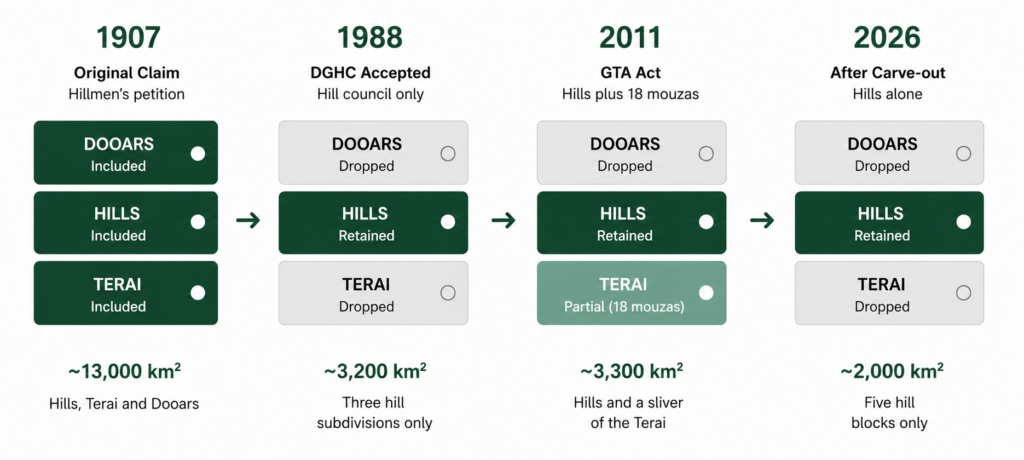
The Gorkhaland demand at its origin was for a contiguous territory of roughly thirteen thousand square kilometres covering the hills, the Terai and the Nepali-majority Dooars. Look at a map of that territory today and trace what has been taken from it, one administrative decision at a time.
The Dooars came off first. The Nepali-majority blocks of Banarhat, Birpara, Madarihat, Kalchini and Kumargram, with their tea-garden populations of Gorkha and Adivasi workers, were quietly removed from administrative consideration when Subash Ghisingh accepted the Darjeeling Gorkha Hill Council in 1988.
The DGHC covered only the hills. The Dooars demand was deferred, with assurances that it would be addressed in a fuller settlement. It never was. Forty years later, those blocks remain in Jalpaiguri and Alipurduar districts, administered by DMs who have no political stake in the Gorkha question.
An entire wing of the original homeland was traded for a hill council, and the hill leadership of the day accepted that trade.
The next reduction came with the 2011 GTA Act, when Bimal Gurung signed an agreement that covered the hills plus eighteen mouzas of Siliguri sub-division. Eighteen mouzas out of an originally claimed territory containing many more.
The rest of the Terai was again deferred. The political logic was familiar. A bigger council than the DGHC, more powers, more positions, more patronage. In exchange, a smaller territory than originally claimed. The Gorkha leadership of the day accepted that trade too.
Now the proposed Siliguri district takes those eighteen mouzas off the table altogether. After the carve-out, the Terai is no longer even nominally within reach of any future Gorkhaland settlement. What began as a claim to roughly thirteen thousand square kilometres of hills, Terai and Dooars is being reduced, by successive administrative decisions made over forty years, to roughly two thousand square kilometres of hills alone.
Each reduction was accepted by the hill leadership of the time on the same logic: the offer of a kingdom, however small, in exchange for the surrender of a claim, however historic.
It is worth saying this plainly, because no one in the hill leadership has been willing to. The geographical fragmentation of the Gorkha homeland has not happened only because successive state governments wanted it. It has happened because successive generations of hill leaders preferred the certainty of a position over the uncertainty of a principle.
Ghisingh chose the DGHC chairmanship over continuing the Gorkhaland agitation in its full territorial form. Gurung chose the GTA chief executive’s office over insisting on the full territorial scope of the original demand. Anit Thapa today runs a GTA whose boundaries were drawn by an agreement his predecessor signed and whose territorial claim he has not publicly insisted upon since taking office. Each generation of leadership has accepted a smaller body with greater personal authority in place of a larger claim with greater collective meaning. The Gorkhaland map has shrunk in exact proportion to the careers built on its diminution.
The Siliguri district proposal asks the current generation of hill leadership to make the same trade one more time. To accept the carve-out, quietly, in exchange for the continued running of a hill council whose territory shrinks every decade. If they accept it, the next reduction is not difficult to imagine. A future state government, looking at a Darjeeling district reduced to five hill blocks and seven lakh people, will note that the hills could be reorganised more efficiently still. There will be proposals to merge sub-divisions. To rationalise municipal boundaries. To absorb the GTA into a more compact administrative unit. Each of these will be presented as a small adjustment. Each will be accepted, if past is prologue, in exchange for some new sinecure.
The hill leadership must understand that there is no point at which this process stops by itself. It stops when the leadership refuses to trade territory for position. The Siliguri carve-out is the place to refuse. After it, there is not much left to refuse over.
Figure 3: The Gorkhaland territorial claim, compressed across four decades.
The habit of protesting too late
There is a second pattern, related to the first, that the hills must break if any of the above arguments are to matter. It is the habit of reacting to decisions only after they have been finalised.
The history of the Gorkhaland movement, viewed honestly, is a history of bandhs called too late. The agitation of 1986 to 1988 came after decades of administrative decisions had already settled the status quo. The bandh of 2007 came after the DGHC’s territorial limits had been accepted for nineteen years. The bandh of 2013 came after the GTA Act of 2011 had already codified the eighteen-mouza compromise. The hundred-and-four-day bandh of 2017 came after the GTA was already a functioning institution running on the very terms the bandh purported to reject.
Each agitation was a protest against a decision the hill leadership had failed to oppose at the moment it was being made. Each ended in an exhausted negotiation that delivered less than the bandh had demanded.
This is not a coincidence of personalities. It is a structural failing of how hill politics has organised itself. The Gorkha public discourse mobilises around symbols and grievances after the administrative substance has been settled, rather than engaging with the administrative substance before it hardens. Decisions are taken in cabinet rooms in Kolkata and Delhi while hill leaders are touring constituencies.
By the time the gazette notification arrives, the political space for opposition has already collapsed into the narrow choice between a destructive bandh and a humiliating acceptance.
The proposed Siliguri district is, at this moment, still a proposal. It is a 2025 letter from a BJP MLA to a chief minister, picked up by a 2026 state government that may yet be persuaded to slow down. It has not been gazetted. It has not been notified. The asset-transfer arithmetic has not been published. The consultation with the GTA has not happened. The political risk assessment for the Gorkhaland and Kamtapur questions has not been written, let alone debated. This is the window in which proactive opposition can actually shape the outcome. After gazette notification, the only response left will be a bandh, by which time the carve-out will be administratively irreversible and a thousand crores of business will have been lost in the hills and the plains for a result that was decided months earlier.
The hills must learn, before another decade of reactive politics passes, that statehood is built in the years before the decision and not in the weeks after it. Memorandums must be filed now, while the proposal is still a letter. Legal opinions must be sought now, while the cabinet has not yet considered it. Cross-party hill meetings must be convened now, while the issue is still amenable to compromise.
The tea industry, the chambers of commerce, the university faculty, the GTA, the church and monastery networks must be persuaded to take public positions now, while their positions can still influence the drafting of the proposal. Memoranda submitted after gazette notification end up in archive folders. Memoranda submitted before it end up in cabinet briefing notes.
This requires a different kind of politics than the hill leadership has practised for forty years. It requires patience. It requires research. It requires the willingness to engage with state-government file numbers and central-government interlocutor schedules rather than with the more emotionally satisfying language of grievance.
It is, in short, the politics of foresight rather than the politics of reaction. The Gorkhaland movement, if it is to mean anything at this stage of its history, must learn to fight for its territory at the moment the territory is being redrawn, not in the months after the new map has been printed.
Table 3: Major Gorkhaland bandhs and the decisions they were reacting to.
| Year | Bandh / Agitation | Decision it was reacting to | Years late |
| 1986–88 | Gorkhaland agitation | Decades of admin decisions already settled | decades |
| 2007 | Hill bandh | DGHC (accepted 1988) | 19 yrs |
| 2013 | Hill bandh | GTA Act (2011), 18-mouza compromise | 2 yrs |
| 2017 | 104-day bandh | GTA already running under terms protested | 6 yrs |
Why every hill politician must speak, and what their silence so far reveals
This is what makes the silence of the hill leadership the single most disturbing feature of the present moment.
Anit Thapa’s Bharatiya Gorkha Prajatantrik Morcha, which controls the GTA, has issued no public position on the Siliguri district proposal. Yet the GTA’s territorial coherence depends precisely on those eighteen Siliguri sub-division mouzas remaining within reach of any future settlement. BGPM lost the Darjeeling assembly seat to BJP’s Noman Rai in 2026. It cannot afford a second strategic loss by default.
Bimal Gurung’s Gorkha Janmukti Morcha, the original architect of the post-Ghisingh phase of the Gorkhaland movement, has been quiet. Mann Ghisingh’s Gorkha National Liberation Front, the formal custodian of the founding demand, has been quiet. Ajoy Edwards’ Hamro Party and the Indian Gorkha Janshakti Front, which built their political identity on a critique of the older parties’ inertia, have been quiet.
The two BJP MLAs who proposed this, Anandamay Barman and Shankar Ghosh, owe their constituents an explanation of how a separate Siliguri district is compatible with the Permanent Political Solution that their own party’s MP from Darjeeling, Raju Bista, has been demanding since 2019.
Bista himself has so far avoided the question. He cannot keep doing so. The Darjeeling Lok Sabha constituency covers every assembly seat at stake. If its MP cannot articulate a position on whether these blocks belong administratively to the hills or to the plains, the seat itself has stopped speaking for its people.
The tea industry has stayed out of the conversation. So have the chambers of commerce, the hoteliers, the transport associations, the university faculty, the church and monastery networks. Each of them stands to be directly affected. Each of them has, until now, treated this as a debate for politicians. It is not. It is a debate about which DM signs which licence, which sub-divisional officer routes which welfare scheme, which Commissionerate registers which company.
Silence will not protect them from the consequences. It will only make them irrelevant to a decision being taken about them.
The right way to do this, if it must be done
We are not blind to the problems of Siliguri. None of this is an argument that Siliguri’s current governance arrangements are adequate. They are not. Siliguri’s urban agglomeration of more than twelve lakh people, expanding to roughly eighteen lakh across the wider area proposed for the new district, cannot reasonably be administered from a hill district headquarters more than seventy kilometres away.
The Siliguri Mahakuma Parishad model has run out of administrative road, and there is a legitimate case for stronger local governance for the Siliguri urban area, but the legitimate response to that problem is not a unilateral district carve-out.
It is, at minimum, three things. First, a public feasibility study covering revenue impact on Darjeeling and Jalpaiguri, the asset-transfer arithmetic, and a formal political risk assessment for the Gorkhaland and Kamtapur questions, published in full, not whispered between cabinet secretaries.
Second, a formal consultation with the GTA, with hill parties of every persuasion, with Adivasi and Rajbanshi community organisations whose ancestral territories are also at stake, and with the Centre’s Permanent Political Solution interlocutor.
Third, an explicit written commitment, gazetted, not merely promised, that the creation of any Siliguri district does not foreclose the territorial scope of the Gorkhaland settlement currently under negotiation and Siliguri if a district made will be a part of the state created.
If those three things cannot be done, the proposal should not proceed. If they can be done, the hills will have a fair say. Either way, the present trajectory of a 2025 MLA’s letter, a sympathetic 2026 government, no public study, no consultation and no commitment, is unacceptable.
First restore, then separate
If, despite all of the arguments above, the new state government is determined to proceed with a separate Siliguri district, there is one further principle that must be conceded before any line is drawn. It is a principle that gives the carve-out, at minimum, the moral cover of fairness rather than the appearance of theft.
It is this. For forty years, institutions and infrastructure built in the name of Darjeeling district have been physically placed in Siliguri, paid for out of allocations attributed to a district whose hill sub-divisions saw none of the actual investment. The University of North Bengal, the North Bengal Medical College, the North Bengal Dental College, the Tea Board’s Siliguri Regional Office, the Siliguri Tea Auction Centre, the Regulated Market for hill produce, the airport runway upgrades, the AH-grade highway alignments, the upgraded NH 10 to Sikkim. Every one of them was funded as Darjeeling district development. Every one of them serves the hills nominally. Very few of them serve the hills in practice. The hills have been the financial guarantor and the brand-name of a development pattern that has benefited the plains.
If Siliguri is now to be carved out as a separate district, those accumulated investments cannot simply walk out unaccompanied. The principle that must be established, in writing, in cabinet resolution, gazetted before any district notification, is that separation requires restitution.
What was built in the hills’ name must, before the line is drawn, either be relocated to serve the hills, or be financially settled in their favour, or be placed under joint administrative arrangements that guarantee hill access and a hill revenue-share.
In concrete terms, that means at least four things. First, a one-time capital settlement transferred from the new Siliguri district to the residual Darjeeling district, calculated on the audited share of central and state allocations attributed to Darjeeling district that were physically spent in Siliguri sub-division over the last twenty years.
Second, a commitment to build hill-located satellites of the major institutions. These would include a North Bengal University campus in Kurseong or Darjeeling, a tertiary referral hospital in the hills with referral parity to NBMCH, a tea auction sub-centre with priority handling for GI-marked Darjeeling tea, and a fully operational airstrip in the hills with state subsidy on essential connectivity routes.
Third, ongoing revenue-share arrangements on the trade of Darjeeling-branded produce, since the “Darjeeling” name remains owned by the hills regardless of which district handles the auction.
Fourth, joint administrative arrangements over the Siliguri Tea Auction Centre, the Tea Board Siliguri Regional Office and the Siliguri Regulated Market, with formal hill representation on their governing bodies.
These are not radical demands. They are the minimum that any honest district reorganisation in India should provide, and they have in fact been provided elsewhere.
When Telangana was carved out of Andhra Pradesh in 2014, the financial settlement between the two states ran into thousands of crores and inter-state asset-sharing arrangements continue to this day. When Uttarakhand was carved out of Uttar Pradesh in 2000, large parts of the legacy administrative apparatus were either physically relocated to Dehradun or settled in the new state’s favour. The Kalimpong carve-out of 2017, by contrast, transferred few accumulated assets because Kalimpong had few. The Alipurduar carve-out of 2014 was geographically clean.
Siliguri’s case is qualitatively different from both. It would take with it the single largest concentration of accumulated public investment in any West Bengal district bifurcation since the state was constituted. That makes the restitution principle non-negotiable.
The proposal currently on the table makes no such provision. It assumes, silently, that the hills will accept the carve-out and the asset transfer as a fait accompli. It assumes they have already conceded their claim to forty years of investment recorded in their name. The hills must insist on the opposite principle. Nothing leaves without an honest accounting. First restore, then separate. If the new state government refuses, the answer is straightforward. The carve-out cannot proceed.
A decision being made in your name
The people of Darjeeling district, in both the hills and the plains, are about to have a decision made about them without being asked. They will lose their airport, their medical college, their university, their international borders and the better part of their economic base. They will, in addition, lose the territorial integrity of a Gorkha claim that pre-dates Indian Independence itself, not by argument, not by referendum, not by parliamentary debate, but by an administrative notification quietly tabled at a state cabinet meeting and signed into effect.
This is the moment for the hill leadership to speak. The list of those who must speak includes BGPM, GJM, GNLF, Hamro Party, the BJP MP, the BJP MLAs who proposed it, the tea industry, the hoteliers, the academics, the church and monastery networks, and the civil society of Darjeeling town, Kurseong, Kalimpong and Mirik. Not in private channels. Not after the fact. In public, in print, in the Assembly, in the Lok Sabha, in the streets if necessary.
The case against this proposal can be made on revenue grounds, on connectivity grounds, on people’s welfare grounds, on Gorkhaland-question grounds. Any one of those would be sufficient. Taken together, they are overwhelming.
The hills have been told for forty years that their demands are too inconvenient, too divisive, too premature, too late. They have been asked to wait. While they have waited, the plains beneath them have been administered, developed, contested and, now, prepared to be detached.
The proposal to carve Siliguri out of Darjeeling is not a routine administrative reform. It is the most consequential territorial decision affecting the Gorkha people since the GTA Act of 2011, and it is being taken at a faster pace, with less consultation and with fewer legal safeguards.
If the hill leadership cannot find its voice now, when an airport, a university, a medical college, an international border and the territorial heart of its political identity are walking out of the district in a single move, it will not find that voice later. The carve-out, once gazetted, is unlikely to be reversed. The political claim, once fragmented, will be far harder to reassemble.
Speak now. Or accept that what comes next was decided in your silence.
Writes: Anjani Sharma Bhujel

Leave a comment