
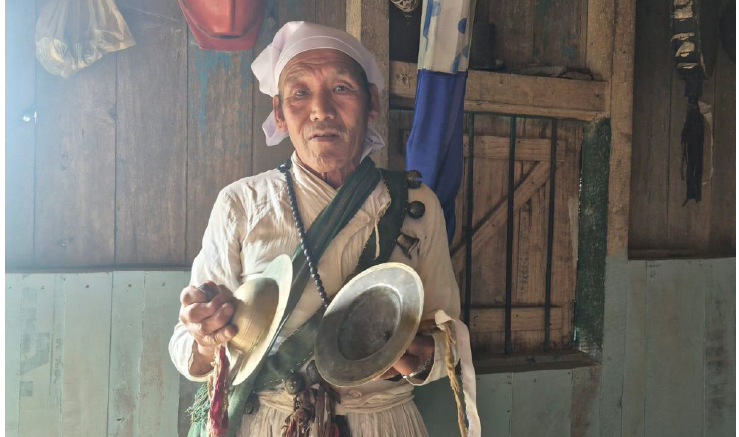
The Sherpa Ponbo of Sherpagaon: The Last Keeper of the Invisible World, Tenzin Nyima Bhutia beautifully paints the slow fading of these ancient practices as younger generations turn to modern ways
Just below Lava Clock Tower, along the winding road into Gairigaon in the Shelpokhari area, lies the quiet Sherpa settlement of Sherpagaon. Like many villages in the Kalimpong hills, it has embraced change without abandoning its identity. Young people leave for higher education and employment, tourists occasionally pass through its narrow roads, and hospitals have become the first place families turn when illness strikes.
Yet inside one ordinary house, another tradition continues.
Seventy-two-year-old Pemsangay Sherpa is the last practicing Sherpa Ponbo of the village. Among the Sherpas, a Ponbo is a ritual specialist, often understood locally as a Jhyakri, who performs healing, divination, and protective ceremonies while serving as an intermediary between the human and spirit worlds through knowledge passed down within particular lineages.
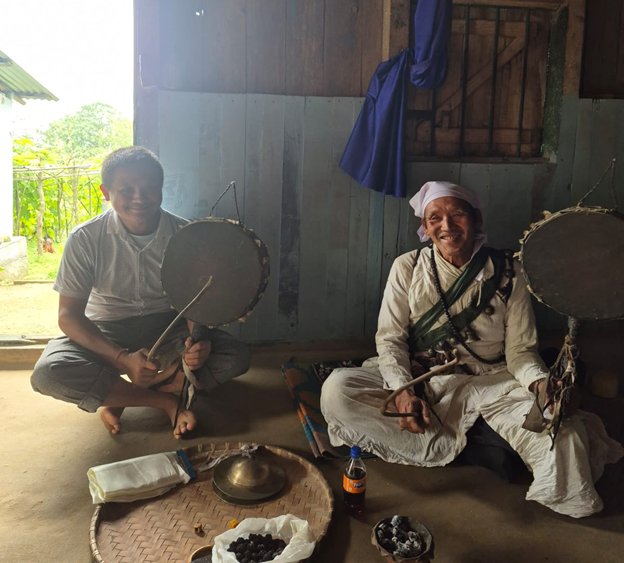
Left: Ashang Kapu, grandson of the late Ponbo Gore Sherpa. Right: Ponbo Pemsangay Sherpa, the last practicing Sherpa Ponbo of Sherpagaon.
Although fewer people visit him today than they once did, families still seek his help when illnesses remain unexplained, troubling dreams refuse to leave, or misfortunes seem beyond ordinary understanding. For him, these visits are neither extraordinary nor mystical.
“I learned from my guru,” he told me simply. “My grandfather-in-law was also a Ponbo. We cannot do more than what our guru taught us.”
There was nothing theatrical about the way he spoke. He made no attempt to convince me of hidden powers or mysterious worlds. Around us, members of his family quietly joined the conversation, correcting forgotten details, recalling older stories, and filling the silences with memories that had survived far longer than any written record.
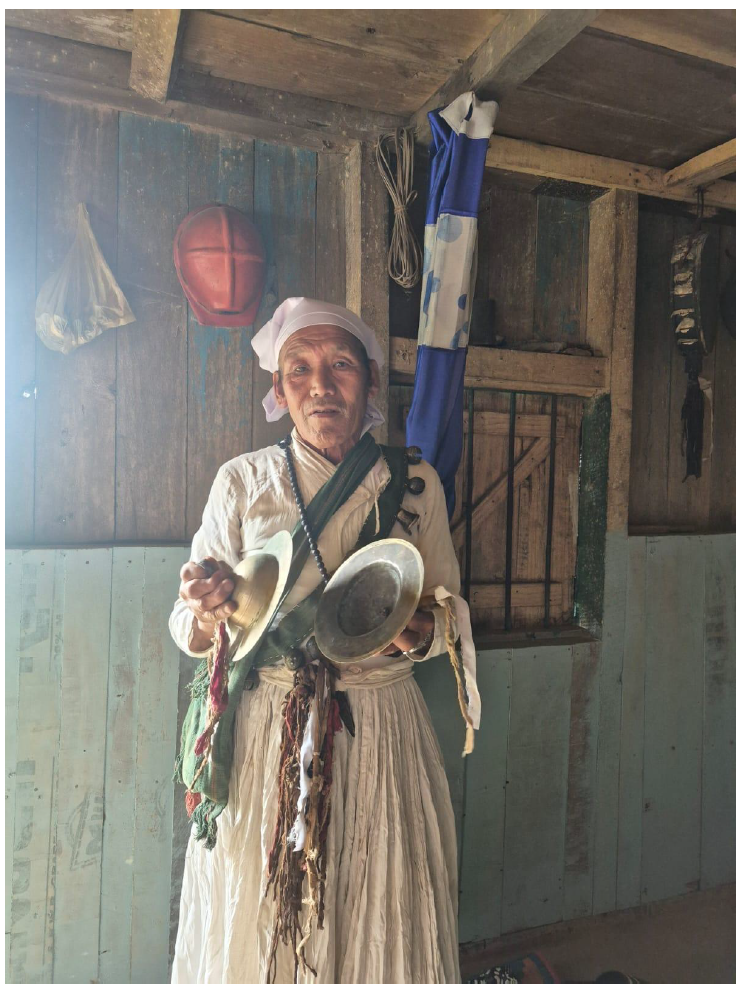
Ponbo Pemsangay Sherpa explaining his ritual implements.
Before long, it became clear that understanding the Ponbo tradition meant listening not only to Pemsangay, but also to the family that had carried its memory across generations.
Again and again, one name returned to the conversation – ‘Gore Sherpa’.
Though he passed away years ago, he remains the most remembered Ponbo in Sherpagaon. There are no biographies of his life, no manuals explaining the rituals he performed, and only a handful of photographs. Instead, his legacy survives through the memories of those who watched him work.
“Gaga (grandfather/village elder) was a bhuifutwa Ponbo,” recalled Dawa Dolma Sherpa. “Whenever he performed chinta, he danced. He had the complete costume and all the ritual objects – a khurmi, an erka, and a thumse.”
Her memories were not of ceremonies observed from a distance but of childhood spent within a household where rituals formed part of everyday life.
“The ritual required two Ponbos,” she explained. “The work was too much for one person alone.”
She remembered the two ritual practitioners calling out to another Ponbo in Sherpa while scattering handfuls of rice back and forth.
“Dha lerong ha khonok.” (Now he knows)
“Dha ngala nging na ki lok” (Now let me return it to where it came from)
To outsiders, it may have appeared as a simple exchange, but within the community it formed part of what was remembered as baan, a ritual contest through which one practitioner’s knowledge and authority met another’s. She recalled him say…
“Hera hera! Chinta baseko chal payi halecha.” (“Look, look! He has realised I’m performing the chinta.)
“Hera hera! Malai jiskayeko.” (Look, look! He’s teasing/challenging me.)
What remained most vivid in her mind, however, was not the ritual itself but Gore Sherpa’s appearance. His long white hair was parted into two braids and tied above his head with a red ribbon. He wore a flowing white robe with long sleeves and carried ritual objects whose names are now remembered by only a handful of elders.
Listening to her, one realised that traditions such as these survive not because they have been written down, but because families continue to tell their stories long after the rituals themselves have become rare.
If Dawa Dolma remembers the past, Gore Sherpa’s grandson, Ashang Kapu, worries about the future.
“When my grandfather died,” he told me, “we entrusted the responsibility to another Ponbo from Maneydara. But we made him promise that if another Ponbo ever emerged from our own family, he would return the responsibility to us.”
For him, becoming a Ponbo is not simply a matter of learning rituals.
“It follows the descendants,” he said. “Sometimes the calling still comes. But people don’t recognise it anymore.”
He believes the decline of the tradition cannot be explained by changing lifestyles alone.
” The old Ponbos were very powerful,” he reflected. “But they never taught anyone. When they died, their knowledge died with them.”
His words point to another reason the tradition has become fragile. The disappearance of the Ponbo tradition is not only the result of modern education or healthcare replacing older systems of healing. Much of its knowledge remained closely guarded, transmitted only to a chosen successor. When that chain was broken, entire worlds of ritual knowledge disappeared with it.
Pemsangay Sherpa’s own journey began not with formal instruction but with dreams.
“It first came through dreams,” he recalled.
Disturbed by recurring visions, he turned to his family, who recognised them as signs familiar from earlier generations. The ritual objects of his grandfather had been carefully preserved, and they encouraged him to seek a guru. The dreams may have pointed him towards the path, but years of discipline and apprenticeship shaped the Ponbo he would eventually become.
Even today, villagers continue to visit him.
“When people think spirits have affected someone, they call me,” he explained. “I perform jokhana with rice. From that I understand whether it is an ordinary illness or whether something else is involved.”
If necessary, he recites mantras, performs ritual blowing, and advises families on what should be done. Yet he speaks with equal respect for modern medicine.
“Nowadays everyone first goes to the hospital,” he said with a gentle smile. “Only a few still come to me.”
Perhaps the most revealing moment of our conversation came when I asked where a Ponbo‘s power comes from.
Without hesitation, he answered, “A Ponbo does not work through gods and goddesses. A Ponbo works through the power of his own kul.”
It was a simple sentence, yet it explained why losing a Ponbo means losing far more than a ritual specialist. It means the disappearance of an entire lineage of knowledge that has survived through memory rather than manuscripts.
As I prepared to leave, I asked him one final question.
“What happens after you?”
He smiled quietly.
“If someone comes after me, they will continue. If not…” He paused. “That is not in my hands.”
When I stepped back onto the village road, motorcycles continued to pass, children still laughed somewhere down the slope, and neighbours greeted one another before continuing home. Nothing suggested that, inside one ordinary house, sat the last practicing Ponbo of Sherpagaon, holding a lineage preserved not through books but through memory, apprenticeship, and family.
Whether another Ponbo will emerge after Pemsangay Sherpa remains unknown. But one thing is certain: traditions disappear long before the last practitioner dies, when their stories are no longer remembered. Recording those stories today is not merely an act of preservation; it is a way of ensuring that one of the Eastern Himalayas’ oldest living traditions does not pass into silence without ever being understood.
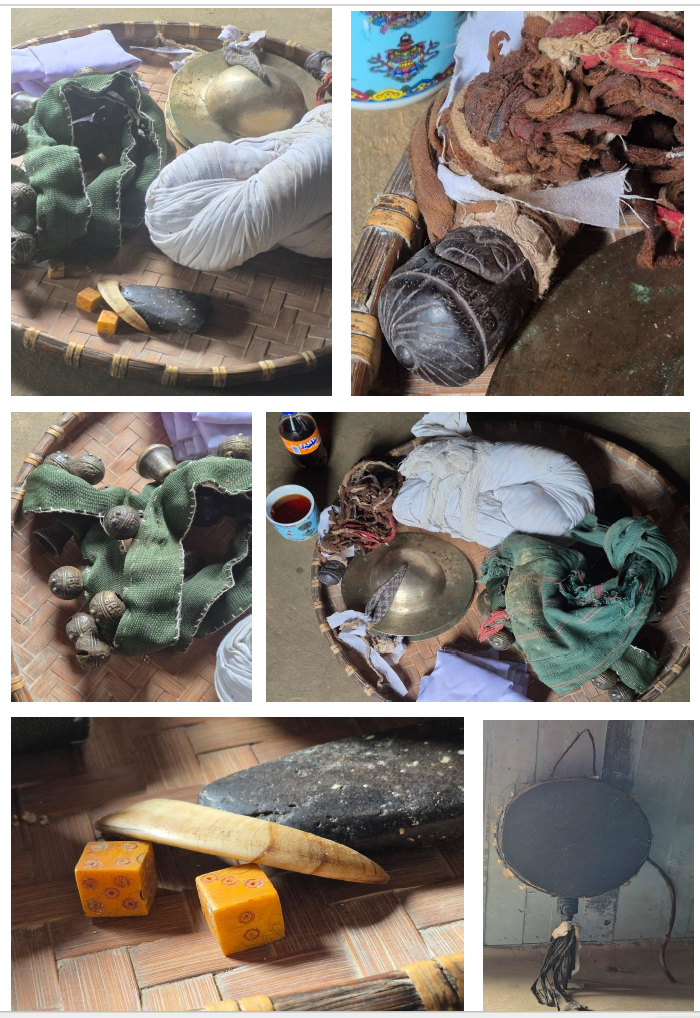
Ritual regalia and ceremonial implements used by Sherpa Ponbos.
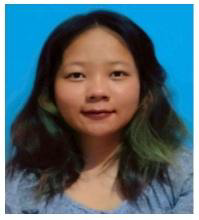
Tenzin Nyima Bhutia is an Assistant Professor of English at Sikkim Manipal University Centre for Distance and Online Education and a Research Scholar in the Department of English at Sikkim University. Her research focuses on the oral traditions, folk beliefs, and indigenous knowledge systems of the Himalayas, with particular interest in documenting endangered cultural practices and community narratives.

Be the first to comment on "The Sherpa Ponbo of Sherpagaon: The Last Keeper of the Invisible World"