
If you know what I am referring to, when I say, “Charana ko Masala… Malai Besi na Chala… Mero Khutta ma Ghau Chha… Malai Bhetnu Bhau Chha”… your childhood was awesome.
If you don’t get the reference, you were probably born too late to belong to that awesome generation, who probably had the most fun growing up. But read on, for someone from your family may have lived this life… may be it will help you understand your mom or dad or uncle or brother or sister better, when they seem to break out on a dance for no rhyme or reason.
The earliest childhood memory that I have, and I am sure same is true for anyone growing up in the 1990s, is being dirty, getting beaten up for being so – Ama washing me thyam-thyam dindai, ali-ali fat-fatindai – scrubbing me clean and sending me back to conquer the world… then in the evening I come back home back in the same state as before Ama bathed me, and getting the same thyam-ki-thyam again.
Kids these days are squeaky clean, chunda panee maila lagla jasto and sadly they look pale.
Life in Darjeeling (and this means all of Darjeeling region, and not just Darjeeling town) back in 1980s and 1990s were simple. As I have written before, we did not have TV till late 1980s and the programs were not shown 24 X 7 like they do these days, we did not have access to video games either.
Whatever little external pleasure could be found, had to be derived from the comics – Phantom, Mandrake, Tinkle, Nagraj, Super Commando Dhruva, Chacha Chowdhury, Suppandi, Shikari Sambhu. But that’s a big topic in itself, and needs a dedicated column for the same.
Other than comics there was no distraction for us, so how did we entertain ourselves?
We played games… outdoors and indoors… mostly in a big group of course.
As I sat down to write about the games we played, it boggled my mind that we had over 30 outdoor games to keep ourselves busy with.
Indoor Games
The most classic of all the games we used to play was perhaps, with our hands on top of each others, gently pinching the one below and we would go… “chi musi chi… musi le khayo dhaan… kaag biralu ko kaan… tero bau mero bau machha marnu goyo… tollai pucchar… malai tauko… hamamamama..”
The next most common game we would play, which had a chance of going slightly nasty was when we would ask someone younger to hold their hand limp and we would shake it gently saying, “lule lule haath… kelle khancha bhaat…” and then we would take their hands and try to hit their mouth with it and say.. “aylley… aylley…” sad if you were at the receiving end of it.
Then we would play katha-bhan-ne game, telling stories – we would all sit in a bed under the sirak and tell each other stories… mostly the stories came from the older kids in the group, and eventually the stories would end up being ghost stories. Now imagine having to go to the loo after the stories ended…
Terrifying, I tell you.
But telling stories may not necessarily qualify as playing games, what does qualify as games though is – Gaon khaney katha… for those who don’t know what it is, the rules were simple, we would ask a riddle and you had to decipher it….
For instance, I could ask you: आफु छ डल्ले… कराउँछ बल्ले Afu cha dalle… Karauncha ball ke ho?
If you knew the answer then fine.
But if you couldn’t, then you’d have to give me a Gaon – a village or a city – say you said ‘lu ni ta Kharsang laija’… then I would go… “Kharsang ma bhako ramro-ramro ghaar… Gadee… Paisa… Saabai mero… tya bhako public toilet… nali… jhoda… ra bogdai gareko guu saaab tero”
The answer is: संख… Conch
At the end of the game, we would count who got more villages, and whoever did that person would be the winner.
We never wasted stuffs, everything was recycled, reused, re-re used. Textbooks from my elder sister would pass onto me, from me to my younger brother and so on. Same was true for the clothes. This practice of recycling was also reflected in our games.
Ok! Honestly how many of your remember – बाई टुक्री Bai Tukri?
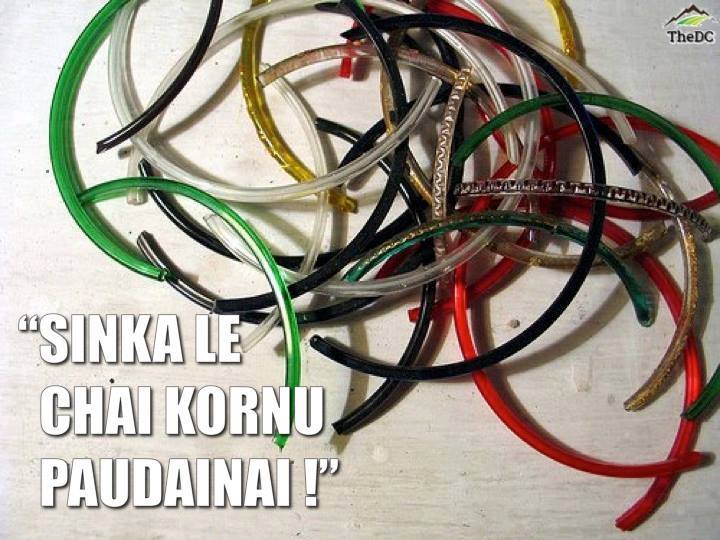
We would take pieces of broken bangles and compete with each other… we would play with 5 pieces each or 10 pieces each… the rule was, you had to throw the bangle pieces on the floor and then use your pinky finger between the two pieces without touching them, and then you had to hit one with the other, if you did, you could pick one of the piece and then move on to the other and so on.. If your finger touched any of the pieces, you had to pay a pre-determined fine of bangle pieces.
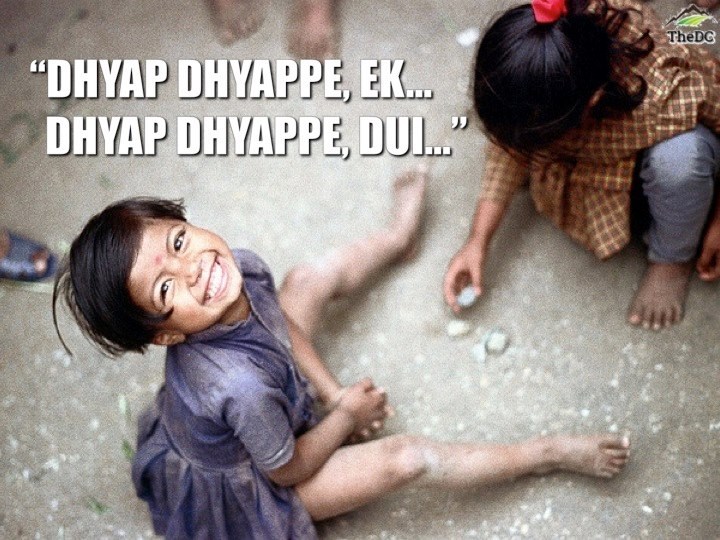
Obviously when we talk of बाई टुक्री how can we not talk of गड्डी? From “Ek tupa ek… ek tupa dui” to “Dhyap-dhyape ek… dhyap-dhyape panch” we would throw a stone and try to grab others and eventually score by successfully getting all the stones through the rim of our one hand. Who ever scored would say, “tolai ek ghar lagyo hai” and would draw a small line as a record. Our parents would freak out if they saw that line, as they used to say – ऋण लाग्छ – drawing a line would bring a house under debt.
The other popular game we used to play was Chor-Police. It was the simplest board game ever. We used to have three, four, five, six chits with different royal positions written down, along with one police and a thief. Each player would pick up a chit and who ever got the King would order, “police-police chor ko pakro”… if the police arrested the one with “Chor” written on his chit she would get the points, but if she made a mistake, then the chor would end up getting her points.

Bhara-kuti will remain an eternal favourite for everyone, irrespective of your gender. I find it funny, that I would always become a shopkeeper. I used to make my taraju from polish ko batta… for oil we used to use kaulo ko bich ko… then a variety of plants would qualify as masu, unda, saag and so on.
One local indoor game which I so want to learn is – Para Syo… this game looks fascinating… does anyone know how to play it?
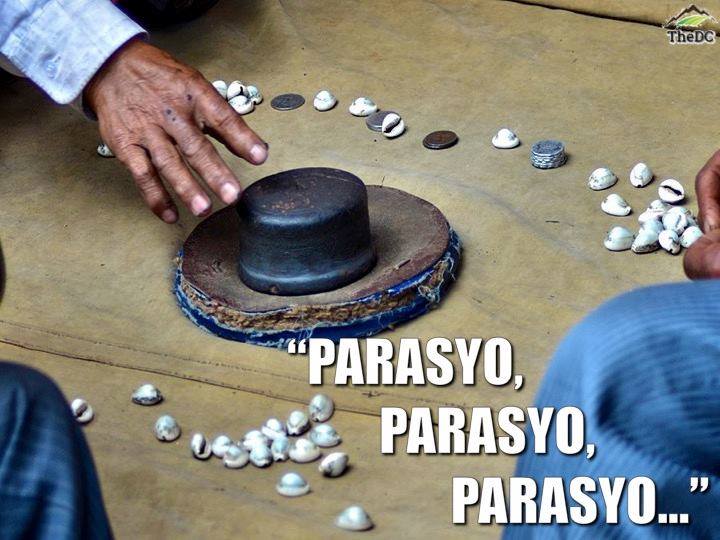
There are many many more indoor games, but some people have complained in the past that my articles are too long, so out of respect for their sentiments I will keep my recollection of the indoor games up to here.
Outdoor Games
Thing is, we would only stay indoors if it was raining, else we would be outside playing our hearts out. Everyone is familiar with common games like – Luki-Chori (hide and seek), Chor-Police, Pitthu-Lakku-Pan
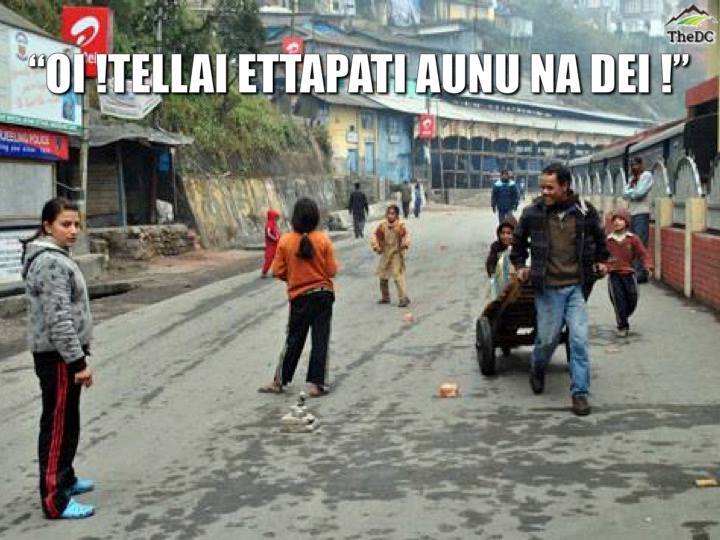
But before every game began we would have unique countdowns to see who would chase or would be the Den… One such rhyme very dear to my heart makes no sense at all, but was fun to recite… “Ambal Dambal khaire paat… dasai koti mahadev… raja rani dum ka dum.. goru ko maasu… toiley maile sungh….”
The rule was each word would be pointed at one player, but if the end was coming to oneself, then we would cheat… by going… towards the end… “toile… mailey… suu…uunggh”
This way the increase in a syllable meant that we would not be the Den but the next person.
Hahaha… ingenious, I tell you.
What I am going to write about are the more traditional Darjeeling games.
Not sure how many of you remember this classic game, where one had to bow down, and two older kids would come up to you and ask… “dhuku-muku dhuku-muku kesko haath?”and the answer would be “raja ko” then one of them would pinch you and the other would hit lightly on your back and ask, “kosley chimatyo, kosle hirkhayo?” if you could say who hit and who pinched you correctly, you could choose who you wanted to go with… else they would decide whom you belonged to… also they would then ask… “kes ma janchas?” and you would have to choose – tool ma, helicopter ma, sutyera and the two elders would then cross hands in different ways and make you sit…the way they crossed their hands would make you feel like you were flying in a helicopter, or sitting in a tool.
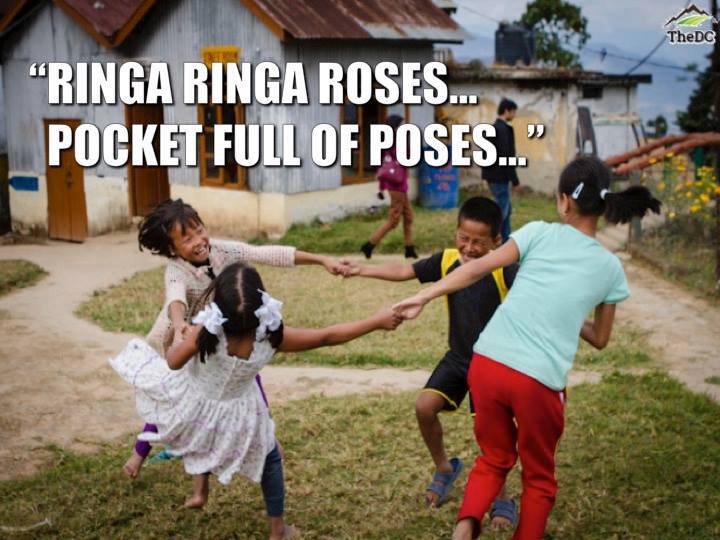
Incredible stuff!!
Then we used to play – “Umm right?” it was actually “Am I Right?” but we used to pronounce it “Umm right?” to play this game, you had to close your eyes and move forward while guessing. The other variety of this would be “डाम – Daam” in which we would use a small dhak ढक and used it to move forward…
I guess this is how we learned the art of balance, and more importantly to trust our instincts and ourselves.
The other popular outdoor game was Macha-Kara माछा काँडा or Chepe-Kara चेपे काँडा… we would tie up rubber bands together to make a big ring, which we would then use to play the game. Usually we played this game in teams, and things could get nasty. Right before someone would play the chepe-kara the one standing with the rubber band around their ankles could ever so slightly move, which would cause the other player to lose his/her balance. Fights would ensue. But all in good fun…
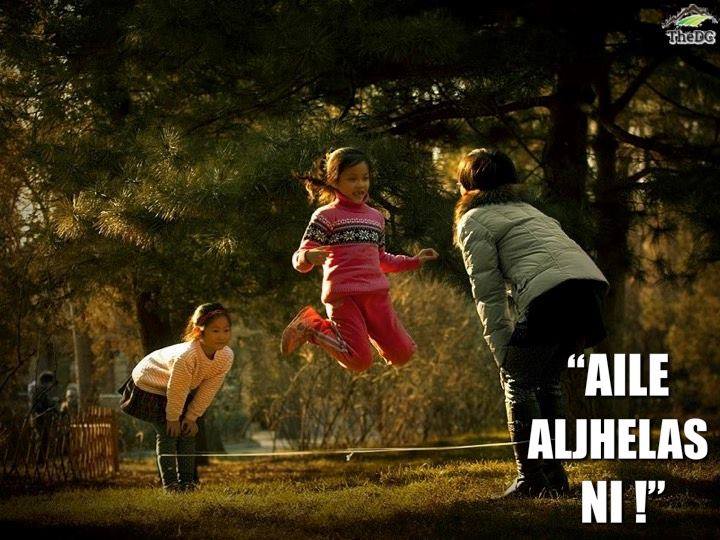
Along with माछा काँडा we had Skip – no we did not have the modern plastic or nylon rope ones, we had skip made of Sutli-Dori. But what we had was fun…
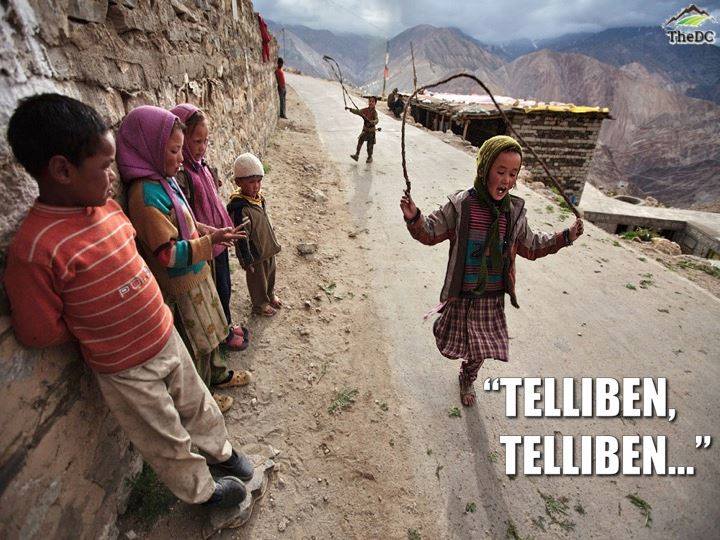
Then we used to play a game called, “Badam ko lagee ko auncha”… In this game we would be divided into two teams and the two teams would face each other. Then we would sing in unison, “बदम को लागी को औंछ… को औंछ… को औंछ… आइताबार को बयानै बयान Badam ko lagee ko auncha… ko auncha… ko auncha… aitabaar ko byaanai byaan” then one of the teams would have to name a player from the other side, say Niten, they would go… बदम को लागी नितेन लाई… नितेन लाई… नितेन लाई… आइताबार को बयानै बयान… the other team in turn would call someone else from the other team and they would indulge in a mini tug of war. Who ever lost the tug, would now belong to the other team, and the game continued till one of the team pulled in everyone from the other side.
A more poetical such game was “Inchu-Minchu London Ma” there would be two older kids and they would hold an arch under which we would have to pass. The song would go… “इन्चु मिन्चु लन्डन मा… हाम्रो बाबा पल्टन मा… सुबेदार को छोरि फकाई देउ… पहिला बिगुल बजाई देउ… किर्लिंग किर्लिंग किर्लिंग झ्याप्प्प” one player would be caught in the arch and got a chance to choose whom they wanted to side with. Eventually even this game ended in a tug of war, but without the rope.
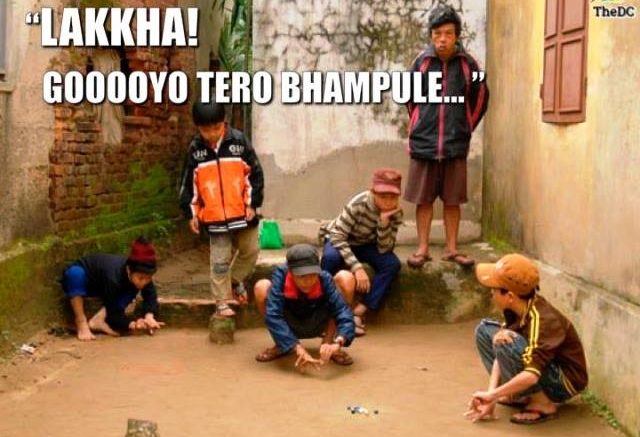
Mejgol were an important and integral part of our growing up years… with marbles we usually played four games –टोप्पा, ढ्याम्पुल, पिल्लौने अनि बिच्चु Toppa, Dhyampul, Pillaune and Bicchu. The rules were simple, in toppa you had to hit the marble pointed by your opponent… in dhyampul you had to hit any other marble but the one pointed out by your opponent… in pillaune you had to first put your marble in a designated hole and then if you hit other’s marble after that, or had hit it before you pillaus… you got to keep your opponent’s marbles. In bicchu you had to clear the marble in the center to be able to get all the marbles surrounding it. Smart ones started by taking the ones in the side and then enter the middle.
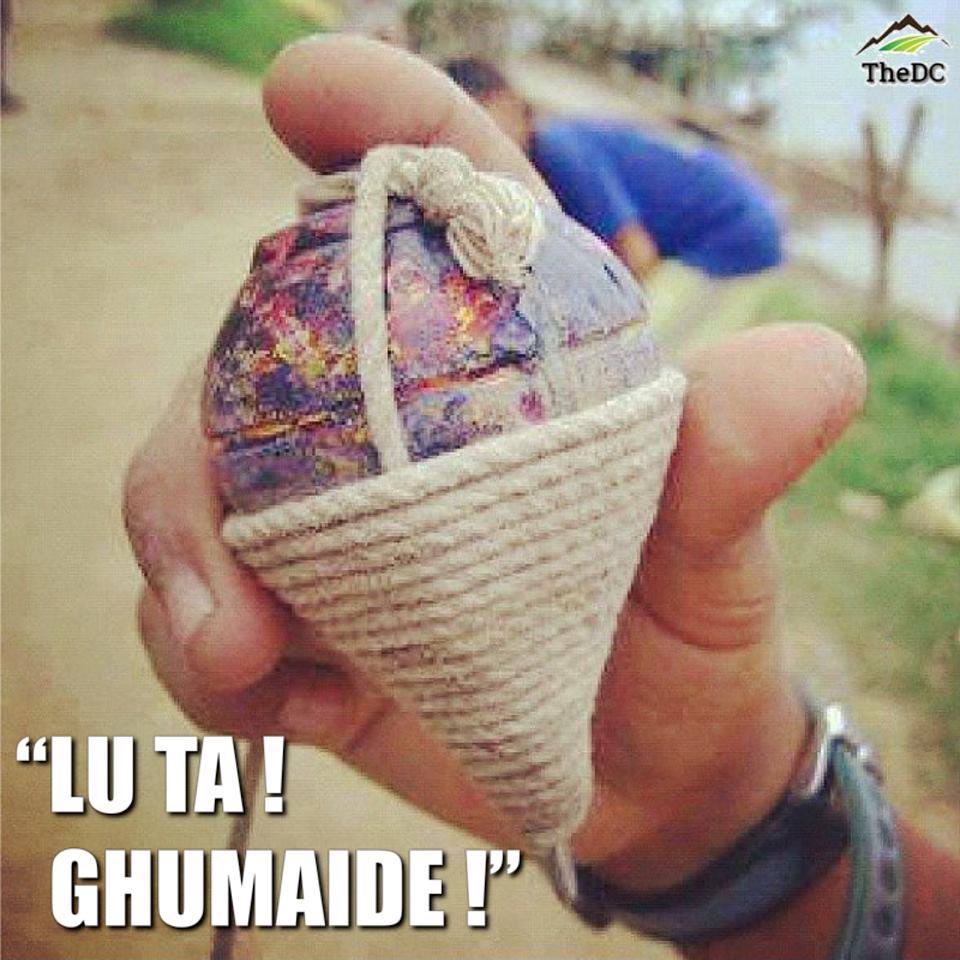
If you were in your teens, you did not play marbles; you played खोप्पी – Khoppi which you played with Coins. This was serious business, as a good win here could mean that you could afford to watch the ‘video’ and also have some change left for eating lal-patthar and Gur (jaggery).
But before the Khoppi or Mejgol we used to play bicchu with Cigarette ko Khol. Believe it or not, we used to collect cigarette covers to play against each other. Charminar, Regent, Charms, Gold Flake, Wills Filter were some popular brands back then. We would take both the sides of a cigarette ko khol and add it to our collection. Much like how kids started playing with wrestling cards in 2000s, kids back in 1990s played with cigarette ko khol.
Nostalgia!!
Not really a game, but one of my fondest memories of childhood has to be Jhir-Gadee, where we would play with a round polythene pipe and a jhir all day… fancying ourselves to be drivers.
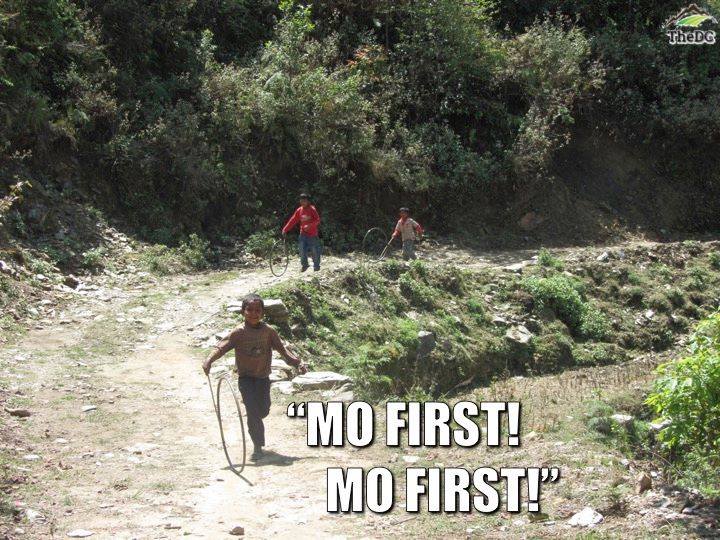
How many of you could turn the ghurra in such a way that it would land on your hands and not on your ground? Yeah!! I knew it, there had to be some…
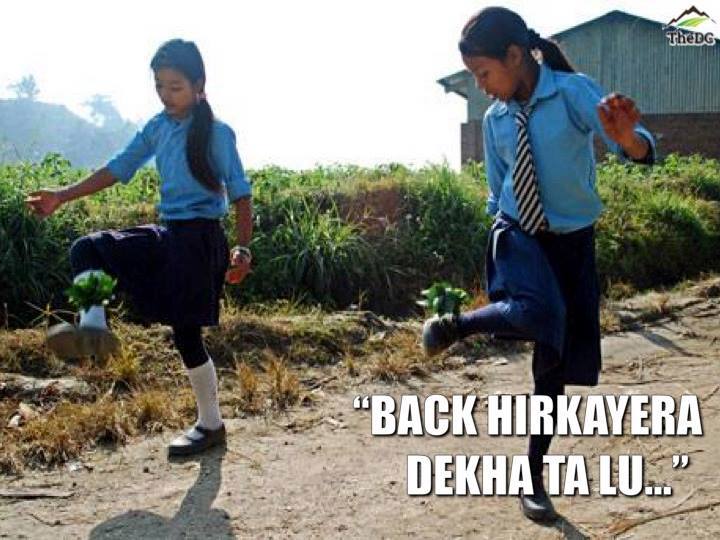
But the most favoured game of all has to be Chungi… I could play chungi all day and all night long. We would play chungi ganney, chungi ko gol halney, chungi joley jharyo out huney, chungi ko volleyball jasto – This one game was even introduced in Darjeeling Carnival once. Darjeeling and Chungi are ubiquitous and I am glad, I grew up in an era when it was one of the most popular games. Those who had money would make labar ko chungi, most of us grew up playing banmara ko chungi like the one shown in the pic below.
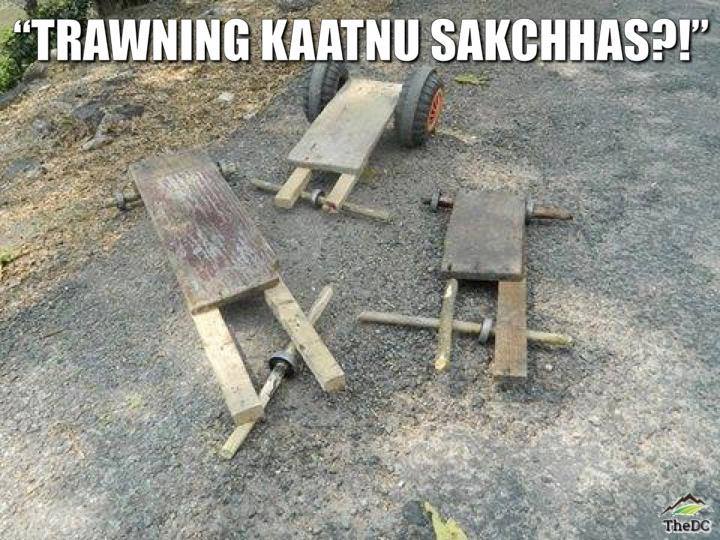
The more daring and naughty kids would play with bearing-gadee… these were little carts, whose wheels were made from bearings of vehicles. This would provide the ultimate thrills… imagine going downhill with no care in the world… and a thin stick up front as your steering… Man I still carry scars from those days. Later we added rubber ko chaplee to both sides in the front, which allowed us to put some brake on the speeding bearing-gadee.
The list can go on and on, but I will stop…. I am too emotional now to write more… as I guess some of you are too.
But I say this with utmost respect to the kids now a days… ‘you guys look pale’… get out… enjoy life, there is wayyyy more to life than what’s shown in the idiot box and your hand-held devices. Parents… send your kids out.. play with them our games… they will have fun and so will you…
There is no substitute for our fresh-air, carefree playing days outside… but this I say, even thinking about those days cheers me up… and makes me want to teach my children all I know from my childhood days… So when I hear a “Charana ko masala… malai besi na chala…” somewhere in my house… I feel blessed… I have continued the tradition…
If this write up brought smile on your face, then please SHARE as I am sure this will cheer up many of your friends as well… and don’t forget to tag your friends… and write in what was your favourite childhood game… this way we can all relieve our past once again…
Author’s note: This writeup is dedicated to my amazing family with whom I grew up… all my childhood friends, and friends who shared my childhood… and my fellow brother Mohan Raj Thakuri ji who has always supported my writings – Thank you
Amidst the political mess, all the negative news and tonnes of ads for materialistic pleasures your writing took me back to a nostalgic Neverland I’d forgotten about. Growing up we played the same games, ran around the kaman bari (tea gardens), burnt jhikra in the winter and came back home in the evening with a black face from all the smoke which resulted in the same thyam-ki-thyam. Surprisingly that never did hold us back from doing the same thing the next day. We made special hiding places, rode old bicycles downhill without brakes, flew kites with home made manja(flour and broken pieces of glass in the thread)…and the list goes on.
Thank you sharing this, it truly made my day.
J hos purano yaad taja vayo …yo Sapai hahahaha means sabai kheleko game haru yaad ayo ajai u forget to mention winter lagnu saat ghuddi Urawnu and bari bari ko kanla ma lukera mato ko dheka ko bomb ,grenade banayera fyakne deep guli, khoppi ,bhitte match stick ko khol wrestling ,Gilli danda lai ta k po vanxa I forget luga /thangna ko ball ko football hatti chap chapel lo gadi…..
Enjoyed going through this writing.It was kind of walking down the most cherished memory lane.Even being a girl I was expert playing “berring gadi” and once had a nasty bruise on my arm which had taken quite sometime to heal but I never stopped playing. I used to hv different types of “cigarette ko khol”,but my favourite being the green n white”Cool”.Along with them I had the collection of stone”Dhakkas”. Those were the days and I really appreciate yr effort of let us re-live those days once again.